
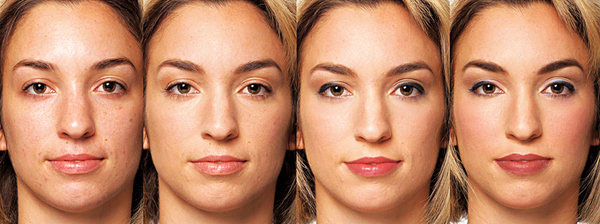
Why do women wear make-up? Is it to influence the way they feel or the way they are perceived by others?
Do you want more respect, trust and affection from your co-workers?
Wearing make-up — but not gobs of Gaga-conspicuous make-up — apparently can help. It increases people’s perceptions of a woman’s likeability, her competence and (provided she does not overdo it) her trustworthiness, according to a new study, which also confirmed what is obvious: that cosmetics boost a woman’s attractiveness.
It has long been known that symmetrical faces are considered more comely, and that people assume that handsome folks are intelligent and good. There is also some evidence that women feel more confident when wearing make-up, a kind of placebo effect, said Nancy Etcoff, the study’s lead author and an assistant clinical professor of psychology at Harvard University (yes, scholars there study eye shadow as well as stem cells). But no research, till now, has given make-up credit for people inferring that a woman was capable, reliable and amiable.
The study was paid for by Procter & Gamble, which sells CoverGirl and Dolce & Gabbana make-up, but researchers like Professor Etcoff and others from Boston University and the Dana-Farber Cancer Institute were responsible for its design and execution.
The study’s 25 female subjects, aged 20 to 50 and white, African-American and Hispanic, were photographed barefaced and in three looks that researchers called natural, professional and glamorous. They were not allowed to look in a mirror, lest their feelings about the way they looked affect observers’ impressions.
One hundred forty-nine adults (including 61 men) judged the pictures for 250 milliseconds each, enough time to make a snap judgment. Then 119 different adults (including 30 men) were given unlimited time to look at the same faces.
The participants judged women made up in varying intensities of luminance contrast (fancy words for how much eyes and lips stand out compared with skin) as more competent than barefaced women, whether they had a quick glance or a longer inspection.
‘I’m a little surprised that the relationship held for even the glamour look,’ said Richard Russell, an assistant professor of psychology at Gettysburg College in Gettysburg, Pa. ‘If I call to mind a heavily competent woman like, say, Hillary Clinton, I don’t think of a lot of make-up. Then again, she’s often onstage so for all I know she is wearing a lot.’
However, the glamour look wasn’t all roses.
‘If you wear a glam look, you should know you look very attractive’ at quick glance, said Professor Etcoff, the author of ‘Survival of the Prettiest’ (Doubleday, 1999), which argued that the pursuit of beauty is a biological as well as a cultural imperative. But over time, ‘there may be a lowering of trust, so if you are in a situation where you need to be a trusted source, perhaps you should choose a different look.’
Just as boardroom attire differs from what you would wear to a nightclub, so can make-up be chosen strategically depending on the agenda.
‘There are times when you want to give a powerful ‘I’m in charge here’ kind of impression, and women shouldn’t be afraid to do that,’ by, say, using a deeper lip colour that could look shiny, increasing luminosity, said Sarah Vickery, another author of the study and a Procter & Gamble scientist. ‘Other times you want to give off a more balanced, more collaborative appeal.’
In that case, she suggested, opt for lip tones that are light to moderate in colour saturation, providing contrast to facial skin, but not being too glossy.
But some women did not view the study’s findings as progress.

6 comments
AndreaM
Ok, I’m sold. Makeup for me everyday from now on.
Riekie
It’s a habit of mine to put make-up on for work. Make-up kit is also in the bag, one never knows when you meet up with the big bosses. Don’t need a lot of make-up, but sometimes the imperfections need to be covered and little eyeshadow, mascara and glossy lips makes the world of difference.
Humphreys
I would agree to disagree. I give my skin downtime and do not wear make up to work. I have to admit that i’ve received a couple of compliments on how naturally healthy my skin looks and simply it boosts my confidence knowing i can still look good and give my skin some air.
Maria Meyer
This is such an interesting article, makes me wonder whether I shouldn’t pull the make-up bag closer on a daily basis – LOL
julandism
I believe that if you have good skin and confidence in yourself you dont need to wear make up to work everyday, dont get me wrong if you work in a corporate environment, you probably should, but if you work in a small office like I do it is not always needed. I wear make up on the days that I have meetings or know that clients will be coming in etc but the rest of the time I just give my skin a break. :)
ricebunny
i totally agree makeup is a must for work even a little mascara and lip stain makes a big diffrerence